
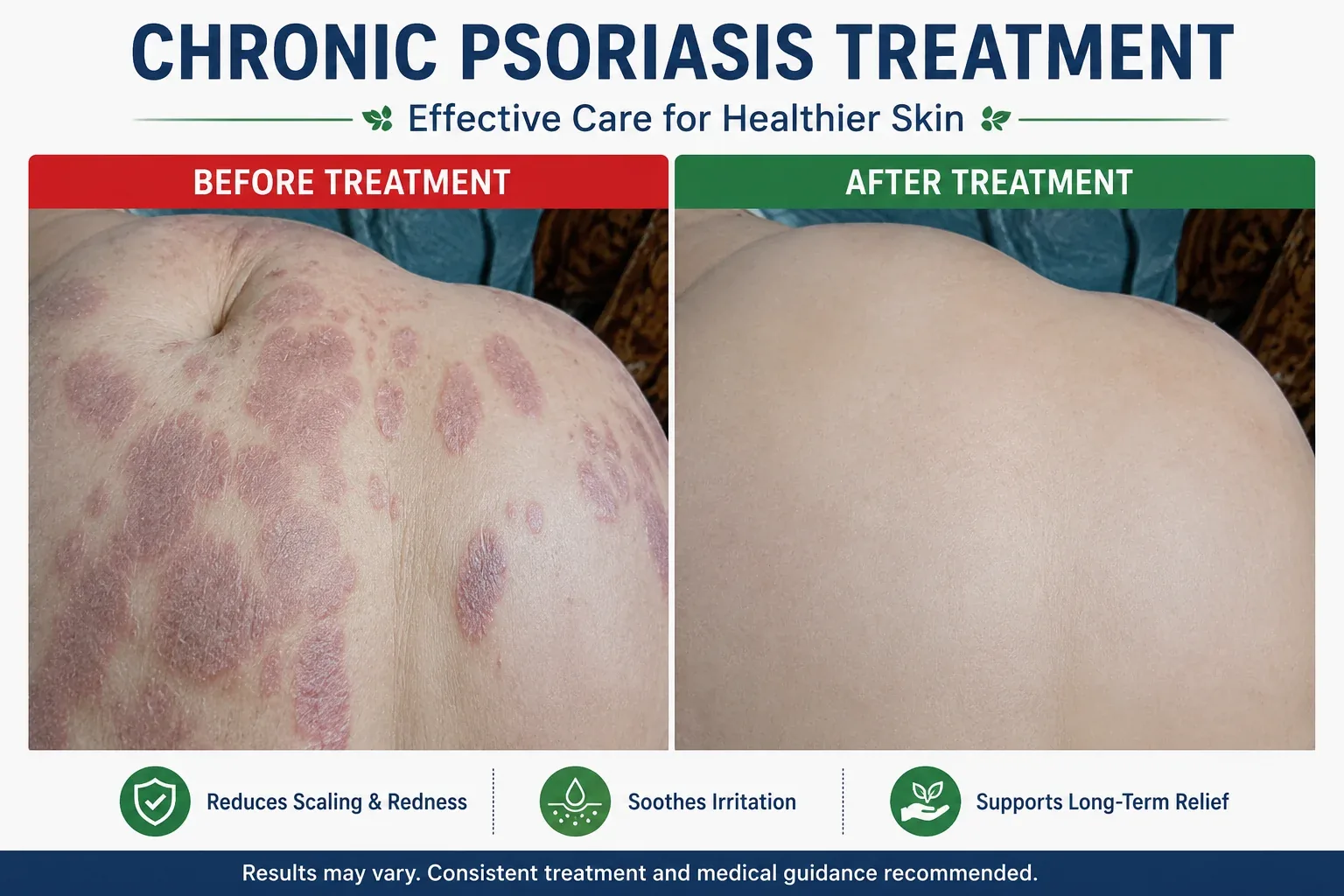
Chronic Psoriasis – Complete Treatment

A few months ago, a 40-year-old woman from Kurali walked into my clinic. Jasvinder had been living with psoriasis for over 25 years. Her thighs, legs, and body were covered in deep, scarred eruptions — pustular at times, intensely itchy, worse every winter. She had been to PGI, consulted multiple homoeopathic physicians, and had been on steroid treatment — both internal and external — for years.
The patches would fade. Then come back — often worse than before.
She sat across from me, emotionally exhausted, and said something I’ve heard hundreds of times in 26 years of practice. She wasn’t asking for a miracle. She had simply stopped believing recovery was even possible. That hopelessness — that quiet resignation — is something psoriasis takes from people long before it takes anything else.
That sentence stays with me. Because psoriasis doesn’t just affect skin — it affects how people show up at work, in relationships, in life. And as a professional yourself, you know exactly what I mean.
Today I want to share what 26 years of treating psoriasis and autoimmune conditions has taught me — including the one truth that most patients never hear from their doctors.
Psoriasis is not a skin disease. It is a system in distress.
I say this to every new patient who visits my clinic, and I’ll say it here too: psoriasis is an autoimmune condition. Your immune system — the very system designed to protect you — begins to attack healthy skin cells, accelerating their growth cycle from a normal 28 days to just 3–4 days. The result? The build-up of thick, inflamed plaques on the surface of your skin.
But the skin is only where the problem shows up. The root cause lives much deeper — in immune dysregulation, chronic inflammation, gut health, hormonal balance, and often, unprocessed stress.
Stress is not just a trigger. In many of my patients, it is the primary driver. The long hours, the performance pressure, the sleepless nights, the emotional weight carried silently for years. Your skin keeps the score when your mind cannot.
Why suppression is not the same as healing
Here is the truth that most patients are never told directly:
Steroids and immunosuppressants manage the expression of psoriasis. They do not correct the immune imbalance that causes it.
This is not a criticism of conventional medicine — it has its critical place. But when a patient applies a corticosteroid cream and the patch disappears, it can feel like a cure. It rarely is. The immune trigger remains. The skin responds again, often more aggressively, the moment the medication stops.
Over time, many patients develop steroid resistance — the medicines that once worked stop working. And some end up with thinned skin, hormonal disruption, or rebound flares that are harder to manage than the original condition.
Jasvinder had lived this cycle for two and a half decades. She is steroid-dependent, repeatedly relapsing, and gradually losing confidence in her own appearance and recovery. It was not a failure of the patient. It was a gap in the treatment approach.
What homoeopathy does differently
When a patient comes to me, the first thing I do is not prescribe. I listen.
I spend a full hour in the first consultation — understanding not just the psoriasis, but the person. Their stress levels. Their sleep. Their digestion. Their emotional history. The patterns in their flare-ups. In Jasvinder’s case, I noted her thermal constitution, her profuse and offensive perspiration, her emotional insecurity, and the deep-rooted fear that her disease was simply incurable — a grief she had been quietly carrying for years.
This is constitutional homoeopathy. We are not treating the skin. We are treating the individual whose immune system has gone out of balance.
The homoeopathic treatment for psoriasis prescribed is matched to the totality of the person — their physical symptoms, their mental-emotional state, and their unique immune pattern. The goal is to gently recalibrate the immune response, not suppress it.
Within 30 days, Jasvinder noticed mild but meaningful changes — reduced itching, slightly better comfort. By November, her eruptions had visibly reduced. By January 2025 — roughly six months into treatment — most of her eruptions had disappeared. Her skin inflammation had settled. Her gut health had improved. And perhaps most importantly, her emotional state had transformed. She told me she felt “more alive” — confident enough to wear clothes of her choice again, after years of hiding.
Her body was no longer her enemy.

5 things every psoriasis patient should know
- Psoriasis is manageable — not just controllable. There is a difference between suppressing symptoms and achieving sustained remission. The right treatment approach can get you to a place where flare-ups become rare, not routine.
- Your gut and your skin are connected. Emerging research consistently links gut microbiome health with autoimmune skin conditions. Diet, digestion, and inflammation are not separate conversations from your psoriasis.
- Stress management is a medical treatment. If your treatment plan doesn’t address stress, it is incomplete. Learning to regulate the nervous system is not optional — it is part of the prescription.
- Long-term steroid use can worsen the root cause. Corticosteroids suppress the immune response temporarily. Prolonged use can create dependency, hormonal imbalance, and rebound flares. Use them wisely and always under medical guidance.
- You can seek integrative support. Homoeopathy and conventional treatment are not always mutually exclusive. Many of my patients use both — with their dermatologist managing acute flares while we work on the deeper immune balance.
A final word
If you are living with psoriasis or an autoimmune condition, I want you to know this: your body is not broken. It is asking for a different kind of attention — one that looks beyond the surface.
In 26 years, I have treated patients from Chandigarh, Delhi, Mumbai, and across the world — Canada, Australia, the USA, and Singapore. I have seen people who had “tried everything” finally find sustained relief, not by adding another suppressive medicine, but by giving their immune system the space to rebalance.
If this resonates with you — or someone you know — I’d love to hear your thoughts in the comments. And if you have questions about whether homoeopathy could help in your specific case, feel free to reach out at allhomoeo.com.
You deserve more than managing. You deserve healing.
